Monday, 15 July 2013

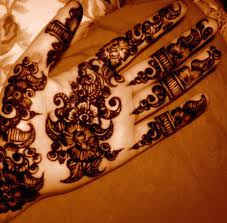
Mehndi Designs Best 2013 Pics Pictures Images Photos

Mehndi Designs Best Biography
source(google.com.pk)
The history and origin of henna is hard to track, with centuries of migration and cultural interaction it's difficult to determine where particular traditions began. There is some historical evidence that henna originated in ancient India as a ceremonial art form. Others believe that Henna was introduced to India in the 12th century. It's been used for at least 5000 years as a cosmetic and for it's natural healing properties. There's also documentation that henna was used in ancient Egypt to stain the fingers and toes of the Pharaohs prior to mummification.

The art form of applying henna (known as mehndi) varies from region to region, this ancient practice has spanned many cultures and traditions. Like all symbols, the varying designs often mean different things to different cultures. It's thus possible to recognize distinctions in cultural style. Arabic designs are generally large, floral patterns on the hands and feet. Whereas Indians (from India) traditionally use fine thin lines for lacy, floral, and paisley patterns which cover their entire hands, forearms, feet and shins; interestingly this is often performed as part of a pre marriage ritual.

Africans and Native/South American Indians tend to prefer bold, large geometric designs done in black. Africans have been known to apply a paste of ashes, ammonia compounds, and other corrosives to get the henna stain from orange to black. This can be poisonous and is NOT a recommended procedure for anyone but a highly trained/experienced professional, severe reactions may result and there've even been reports of deaths. I can only speculate the reason they'd go to such risky lengths is that the natural color of henna (dark brown to dark orange), does not show up well on the dark skin.
Mehndi Designs Best 2013 Pics Pictures Images Photos
 Mehndi Designs Best 2013 Pics Pictures Images Photos
 Mehndi Designs Best 2013 Pics Pictures Images Photos
Mehndi Designs Best 2013 Pics Pictures Images Photos
 Mehndi Designs Best 2013 Pics Pictures Images Photos
 Mehndi Designs Best 2013 Pics Pictures Images Photos
 Mehndi Designs Best 2013 Pics Pictures Images Photos
 Mehndi Designs Best 2013 Pics Pictures Images Photos
 Mehndi Designs Best 2013 Pics Pictures Images Photos
 Mehndi Designs Best 2013 Pics Pictures Images Photos

Mehndi Designs Best 2013 Pics Pictures Images Photos

Mehndi Designs Best Biography
source(google.com.pk)
The history of henna and mehndi is very old and, ultimately, fairly well known. It makes it easy to go back several thousand years. Less greedy, or the more adventurous, evoke the era of the ancient city of Catal Huyuk, there are some 9000 years, in what would much later Turkey. Certain representations relating to the worship of a goddess of fertility tend to think that we used henna in this religious context.
Testimony or other evidence are numerous: there are 5000 years of Egyptian henna stained nails and hair of the mummies, we found traces that of Ramses II the legend of Baal and Anath, written in Syria around 2100 BC JC. reveals the female use of henna on the hands, in the nuptial rites; hands statuettes Minoan or Mycenaean female deities (to 1 700/900 BC. JC). wear marks typical henna patterns the Carthaginians brought the practice of drawing henna body up to North Africa and the Iberian Peninsula … Romans, Jews, Christians and Muslims from Arabia and elsewhere more or less commonly practiced this art.
The introduction in India seems to date back to the fifth s., As might prove discoveries in the caves of Ajanta. In these times, men and women, rich and poor, humans, gods and demons were represented with henna body decorations.But it is, in XII century., The arrival of the Mughals, Muslims, which marks the beginning of a tradition and a culture of mehndi in the Sub-Continent. Rajput rulers of Udaipur (Mewar or at Rajasthan) used the henna application on hands and feet, to name a famous reference. Preparations, application techniques, patterns, then became increasingly sophisticated, and usage patterns increasingly embedded in everyone’s life, according to aesthetic principles, religious, cultural or medicinal. It should be noted that a very typical and traditional occasion the mehndi is use all wedding ceremonies: here you can reach the most ancient practices, mentioned above.
The reasons for Indian mehndi are varied and interlacing geometric figures among Muslims, motifs, often inspired by nature (birds, mango leaves and flowers …) among Hindus, while Tamils ​​resorted to circular designs in the palm and flat colors wrapping fingers and around the feet.
Mehndi Designs Best 2013 Pics Pictures Images Photos
 Mehndi Designs Best 2013 Pics Pictures Images Photos
 Mehndi Designs Best 2013 Pics Pictures Images Photos
 Mehndi Designs Best 2013 Pics Pictures Images Photos
 Mehndi Designs Best 2013 Pics Pictures Images Photos
 Mehndi Designs Best 2013 Pics Pictures Images Photos
 Mehndi Designs Best 2013 Pics Pictures Images Photos
 Mehndi Designs Best 2013 Pics Pictures Images Photos
 Mehndi Designs Best 2013 Pics Pictures Images Photos
 Mehndi Designs Best 2013 Pics Pictures Images Photos

Mehndi Designs Best 2013 Pics Pictures Images Photos

Mehndi Designs Best Biography
source(google.com.pk)
The history of henna and mehndi is very old and, ultimately, fairly well known. It makes it easy to go back several thousand years. Less greedy, or the more adventurous, evoke the era of the ancient city of Catal Huyuk, there are some 9000 years, in what would much later Turkey. Certain representations relating to the worship of a goddess of fertility tend to think that we used henna in this religious context.
Testimony or other evidence are numerous: there are 5000 years of Egyptian henna stained nails and hair of the mummies, we found traces that of Ramses II the legend of Baal and Anath, written in Syria around 2100 BC JC. reveals the female use of henna on the hands, in the nuptial rites; hands statuettes Minoan or Mycenaean female deities (to 1 700/900 BC. JC). wear marks typical henna patterns the Carthaginians brought the practice of drawing henna body up to North Africa and the Iberian Peninsula … Romans, Jews, Christians and Muslims from Arabia and elsewhere more or less commonly practiced this art.
The introduction in India seems to date back to the fifth s., As might prove discoveries in the caves of Ajanta. In these times, men and women, rich and poor, humans, gods and demons were represented with henna body decorations.But it is, in XII century., The arrival of the Mughals, Muslims, which marks the beginning of a tradition and a culture of mehndi in the Sub-Continent. Rajput rulers of Udaipur (Mewar or at Rajasthan) used the henna application on hands and feet, to name a famous reference. Preparations, application techniques, patterns, then became increasingly sophisticated, and usage patterns increasingly embedded in everyone’s life, according to aesthetic principles, religious, cultural or medicinal. It should be noted that a very typical and traditional occasion the mehndi is use all wedding ceremonies: here you can reach the most ancient practices, mentioned above.
The reasons for Indian mehndi are varied and interlacing geometric figures among Muslims, motifs, often inspired by nature (birds, mango leaves and flowers …) among Hindus, while Tamils ​​resorted to circular designs in the palm and flat colors wrapping fingers and around the feet.
Mehndi Designs Best 2013 Pics Pictures Images Photos
Mehndi Designs Best 2013 Pics Pictures Images Photos 

Mehndi Design Best 2013 Pics Pictures Images Photos

Mehndi Design Best Biography
source(google.com.pk)
Enjoy the collection of indian henna designs, indian mehndi design, indian mehndi designs and indian henna designs

In INDIA, is done ‘mehndi night’ before the wedding, a very famous and ancient celebration. It is believed to bring luck and beauty for the bride.

Brides are known Hindu, Muslim, Sikh and Jewish performing ‘mehndi night’. And now, in the Oja you have the opportunity to get a henna tattoo in Bogota or anywhere in the country.

Depending on the source of the dye varies Henna: Henna in India Rajasthan area often have reddish tones, the south is usually more brown sienna, the Yemeni and Moroccan tend to very dark brown tones. The dye does not penetrate the same way throughout the body, the darker colors are obtained and durable body areas with thicker skin and less fat, such as the palms of the hands and feet
Mehndi Design Best 2013 Pics Pictures Images Photos
Mehndi Design Best 2013 Pics Pictures Images Photo 
Mehndi Design Best 2013 Pics Pictures Images Photos 

Sunday, 14 July 2013

Best Mehndi Design 2013 Pics Pictures Images Photos

Best Mehndi Design Biography
source(google.com.pk)
The word Mehndi is derived from the Sanskrit word mendhika.The use of mehndi and turmeric is described in the earliest Vedic ritual books. Haldi(Staining oneself with turmeric paste) as well as mehndi are Vedic customs, intended to be a symbolic representation of the outer and the inner sun. Vedic customs are centered around the idea of “awakening the inner light" .
Henna is 100% organic , natural, safe to use is a unique way to express and enhance your personality by not only lifting your spirit and body but also a form of decorating yourself painlessly !
The for of Henna Art / Mehendi has prooven it`s existsance for more than thousands of years in History and beyond various cultures of the world.
SO WHAT EXCATLY IS HENNA ?
Henna derives from a plant known as Lawsonia Inermis, whose leaves are dried and crushed to make a powder with natural dying properties.These colour dying or tanning properties have been used for centuries for colouring the body , leather , as a hair dye and also fabrices.

The henna plant grows in hot regions and climates and can be found in countries such as India, Syberia ,Morocco, Pakistan, Iran, Syria, Yemen, Egypt, Uganda, Tanzania, Afghanistan, Senegal, Kenya, Ethiopia, Eritrea, and India. It is known by many names, including Henne, Al-Khanna, Jamaica Mignonette, Egyptian Privet, and Smooth Lawsonia. The art of applying henna is referred to as ‘henna’ , 'mehendi ', and ‘mehndi’, depending on which culture or country one comes from.

Henna art - is actually a form of Decorating the Body and symbolises a form of Happiness and has been traditionally used during wedding times to decorate the body of the Bride as she steps into a new phase in her life. This art not only spreads from India to Africa to the Middle East but also in the Western countries , who have embraced the art of henna body decoration-for fashion and beauty, for personal expression, for social and religious occasions, for healing purposes and more.
Henna has been ever popular in Recent times and also shown it`s presence throughout the U.S. and Europe.
Henna not only is present in the anciet cultures but also very prominately gaining popularity in the Today`s lifestyle and is very enthusiastically accepted in people from all ages and walks of lifes.From the Pharaohs of ancient Egypt to modern-day wedding parties, from Morocco to India, henna has enjoyed a variety of applications and meanings throughout the centuries.

Popularized by artists, actors, fashion models and musicians, it has been discovered by thousands of interested individuals from all backgrounds.
Best Mehndi Design 2013 Pics Pictures Images Photos
 Best Mehndi Design 2013 Pics Pictures Images Photos
 Best Mehndi Design 2013 Pics Pictures Images Photos
 Best Mehndi Design 2013 Pics Pictures Images Photos
 Best Mehndi Design 2013 Pics Pictures Images Photos
 Best Mehndi Design 2013 Pics Pictures Images Photos
 Best Mehndi Design 2013 Pics Pictures Images Photos
 Best Mehndi Design 2013 Pics Pictures Images Photos
Best Mehndi Design 2013 Pics Pictures Images Photos
 Best Mehndi Design 2013 Pics Pictures Images Photos

Pics Of Designs Of Mehndi 2013 Pics Pictures Images Photos

Pics Of Designs Of Mehndi Biography
source(google.com.pk)
Henna is a plant (binomial name - Lawsonia inermis) found and grown in South Asian and North African countries. It is used since ancient time to color skin, hair, fingernails, leather, and wool. The name Henna is also used for dye or paste derived from the leaves of the plant, and for the art of temporary tattooing from those paste. The English name "henna" comes from the Arabic, pronounced ħinnā.

1. First used in Egypt more than 5000 years ago. Pharoahs who passed away were painted with henna in order to live a great afterlife and be easily identified.
2. Arrived in India in the 12th century AD during the Mughul period.
3. The Yemenite and North African Jewish communities also put on mehndi for weddings. In Hebrew, henna is called Chenah. Chenah represents the three mitzvot specifically connected to women: Challah(separating the challah), Nida (family purity) and Hadlakat Nayrot(lighting Shabbat candles). (from Jewish Treats)
4. Today, henna is popular amongst the Sephardi and Ashkenazi brides.
5. Muslim styled henna is typical of floral patterns and negative spaces. Objects like the peacock, raja/rani are not permitted as it personifies God.
6. Hindu styled henna is typical of intricate patterns, geometric shapes, and the use of peacocks, mangos, parrots, ranis, Ganesha, and name writing.
7. Henna is an important aspect of warding off the evil eye in Islamic and Jewish traditions. The more henna and intricate the patters on a bride’s hands and feet, the harder it is for the evil eye to find its way to a bride’s forehead.
8. Moroccan women celebrating Id al-Adha wear henna to celebrate springtime and the sacrifice of an animal.
9. When henna was first used, Egyptian men and women would dip their fingers into henna in order to have red tipped fingers. It was considered inappropriate to leave the house without henna’ed hands.
10. Rural North African people still use henna twigs as toothpicks to keep their gums and teeth healthy.
Pics Of Designs Of Mehndi 2013 Pics Pictures Images Photos
 Pics Of Designs Of Mehndi 2013 Pics Pictures Images Photos
 Pics Of Designs Of Mehndi 2013 Pics Pictures Images Photos
 Pics Of Designs Of Mehndi 2013 Pics Pictures Images Photos
 Pics Of Designs Of Mehndi 2013 Pics Pictures Images Photos
 Pics Of Designs Of Mehndi 2013 Pics Pictures Images Photos
 Pics Of Designs Of Mehndi 2013 Pics Pictures Images Photos
 Pics Of Designs Of Mehndi 2013 Pics Pictures Images Photos
 Pics Of Designs Of Mehndi 2013 Pics Pictures Images Photos
 Pics Of Designs Of Mehndi 2013 Pics Pictures Images Photos